
Orleans Parish Release Paths
A person leaves Orleans Parish Sheriff’s Office custody in more than one way. Bond, recognizance, dismissal, acquittal, time served, or completion of a local sentence may result in a return to the community. Probation may begin under the sentencing court. Parole or diminution, often called good-time release, may place a state prisoner under Louisiana supervision. Another exit is a transfer. OPSO can relinquish a booking to the Louisiana Department of Public Safety and Corrections, another parish, the U.S. Marshals Service, the Federal Bureau of Prisons, ICE, a hospital, or another lawful custodian.
That is why “released” must be tied to an agency. An Orleans Parish release date proves that OPSO ended custody on one booking. It does not, by itself, prove that all custody ended. The best record identifies the releasing agency, exact event, legal reason, and any receiving agency. A court minute entry then supplies the order or disposition behind the transaction.
How Orleans Parish Releases Work
Release terms are not interchangeable. “Bonded out” means pretrial jail custody ended under court conditions; it does not resolve the charge. “Time served” ties the sentence to credit already earned. Parole allows release from incarceration while the sentence continues under supervision. Probation is imposed by a judge. A discharge may describe the end of one facility status or the full sentence, so the record must say which.
| Orleans release type | Meaning | Next record |
|---|---|---|
| Bond or recognizance | Pretrial jail custody ends under court conditions. | OPSO release sheet and court bond entry |
| Dismissal, acquittal, or time served | A court event explains why local custody ends. | Certified minute entry and OPSO transaction |
| Probation, parole, or diminution | Confinement ends while supervision may continue. | Court or DPS&C supervision record |
| Transfer | OPSO custody ends, but another agency accepts the person. | Receiving agency locator and transfer record |
Death and escape may also close or alter a custody entry, but neither is a community release. Always retain the source’s exact label. It prevents a transfer date, judicial order, and physical exit time from being merged into one misleading event.
Orleans Parish Release Record Fields
The official OPSO archive begins with the booking. Its observed results include booking number, photograph field, name, date of birth, sex, race, booking date, Release Date, and an active flag. A detail record can add an inmate ID, aliases, charges, statute descriptions, bond type and amount, case number, disposition, and booking history. The archive is useful, but the custodian’s release sheet or chronological custody history is stronger when the release time, code, or destination matters.
A focused Orleans Parish release record request should ask for fields that distinguish freedom from transfer. Do not ask only for “proof of release.” That phrase leaves the key question unanswered.
| Field | What it establishes |
|---|---|
| Booking and inmate numbers | Connects the event to the right OPSO admission. |
| Booking and release date/time | Marks the custody window and actual transaction time. |
| Release type or code | Identifies bond, time served, dismissal, transfer, or another exit. |
| Charge and case number | Links the jail record to the correct Orleans court file. |
| Hold, detainer, or destination | Shows whether another agency received the person. |
| Booking photograph | Links an image to the booking, but proves neither guilt nor release. |
Can the online archive replace the release sheet? No. OPSO has not published a guaranteed archive duration or update schedule. Preserve the displayed Release Date, then request the transaction when an exact time, code definition, or receiving agency is needed.
Note: Match the release field to one booking number before comparing it with a court order or receiving agency record.
Request Orleans Parish Release Records
Louisiana’s Public Records Law supplies the request framework. Address a narrow request to the current OPSO public-records custodian through the official sheriff’s site. Include the full name, aliases, date of birth if lawfully known, OPSO booking number, approximate dates, and court case number. Ask for electronic copies and a fee estimate before chargeable copying. No verified current OPSO copy fee or guaranteed response duration appears in the reviewed official material, so neither should be assumed.
- Identify one booking with the name, booking number, and date range.
- Request the booking sheet, release sheet, custody chronology, actual release date and time, release code and definition, destination, releasable holds, and photograph.
- Ask the custodian to separate public portions from exempt medical, juvenile, victim, investigative, or other protected material.
- If material is withheld, request a written citation to the exemption and production of all nonexempt portions.
- Match the response to the Clerk’s minute entry or other receiving agency record.
R.S. 44:1 and following sections govern access, copying, custodian duties, and enforcement. A request for a state prisoner should instead cite the DPS&C number and target the public disposition, incarceration, sentence, and discharge categories in R.S. 15:574.12(G).
Orleans Release Retention and Expungement
Web visibility and legal retention are different. R.S. 44:36 states a general three-year minimum unless another law or approved schedule controls. It also bars destruction of specified DPS&C adult-offender records until the statutory period after full-term expiration or death. Those rules do not require OPSO or LAVNS to keep the same record online. A missing search result may call for an archival request.
Expungement limits public access after a qualifying court process. Eligibility depends on the disposition, offense, waiting period, record, and other facts under Louisiana Code of Criminal Procedure articles 971 through 995. A sealed, juvenile, or expunged record must not be reconstructed from stale copies. The proper path is the court, counsel, or an authorized agency process.
Code of Criminal Procedure article 228 makes the jail or police book and booking summaries open for inspection. Its required booking core includes the person’s name and address, property taken, and the booking date and time. The article does not promise an online release date or booking photograph. In Orleans, use that legal booking core with the OPSO archive’s displayed Release Date, then request the custodian’s release sheet for the actual exit transaction. This three-part approach avoids claiming that a booking rule creates fields the statute does not list.
R.S. 15:574.12 draws a different line for state corrections records. Presentence, pre-parole, clemency, prison working files, and much Board or department material remain confidential. Subsection G identifies public categories such as general identifying and sentence information, disposition of charges and incarcerations, and the discharge date. A request should target those public categories instead of demanding a full institutional file. The same narrow method applies to Orleans records that contain medical, victim, investigative, juvenile, security, or other exempt content: ask for the nonexempt portion and a written legal basis for each withholding.
Orleans Expungement Processing Time
Orleans has a local processing step after an adult arrest expungement order. The NOPD Records and Identification Division maintains an Expungement Unit and reports that its research process typically takes six to eight months. That estimate concerns agency processing. It is not a promise of eligibility, a court timetable, or instant removal from every system.
Louisiana also addresses commercial remove-for-pay booking-photo publication in Code of Criminal Procedure article 234. Its qualifying request process is separate from the broader court expungement procedure. Official release verification should continue through the lawful custodian and court rather than a copied photo or cached booking page.
Why Orleans Release Records Vanish
New Orleans publishes unusually detailed jail data. The city’s 2024 jail population report counted 9,353 admissions and 9,096 releases. Among people released that year, the median stay was two days. Just over half left within two days, and more than two-thirds left within thirteen days. The average stay among those released was 52 days.
High turnover explains why a present-custody roster performs poorly as a release archive. Many bookings are brief, and the live population changes fast. The OPSO archive checkbox, the Release Date field, the court chronology, and a narrow record request preserve different parts of the event.
Note: The city’s annual totals explain system turnover, but they do not identify or confirm any individual Orleans release.
Find Orleans Parish Released Inmates
Start with identity, then determine the likely custody system. Use a full legal name, aliases, date of birth, booking or DPS&C number, case number, and approximate dates. A name alone can produce the wrong person. Each database answers only its agency’s question.
- Search the current OPSO detainee entry point. A matching active booking normally means OPSO still reports custody.
- Repeat the official inmate search with “Include Archive Records in Search” checked. Record the booking number and Release Date.
- Review Docket Master for the bond action, dismissal, sentence, time-served entry, probation order, or other event. Obtain the Clerk’s certified entry when proof matters.
- If the sentence moved into state custody, search Louisiana VINE through DPS&C and call the locator when the web result is unclear.
- Check agency-specific federal or immigration systems when the case, writ, or detainer points there.
- Submit focused OPSO, DPS&C, Clerk, USMS, or other records requests if online evidence remains incomplete.
The official OPSO archive interface shows the exact local controls used for this process. Open the OPSO archive search before comparing the captured form below.
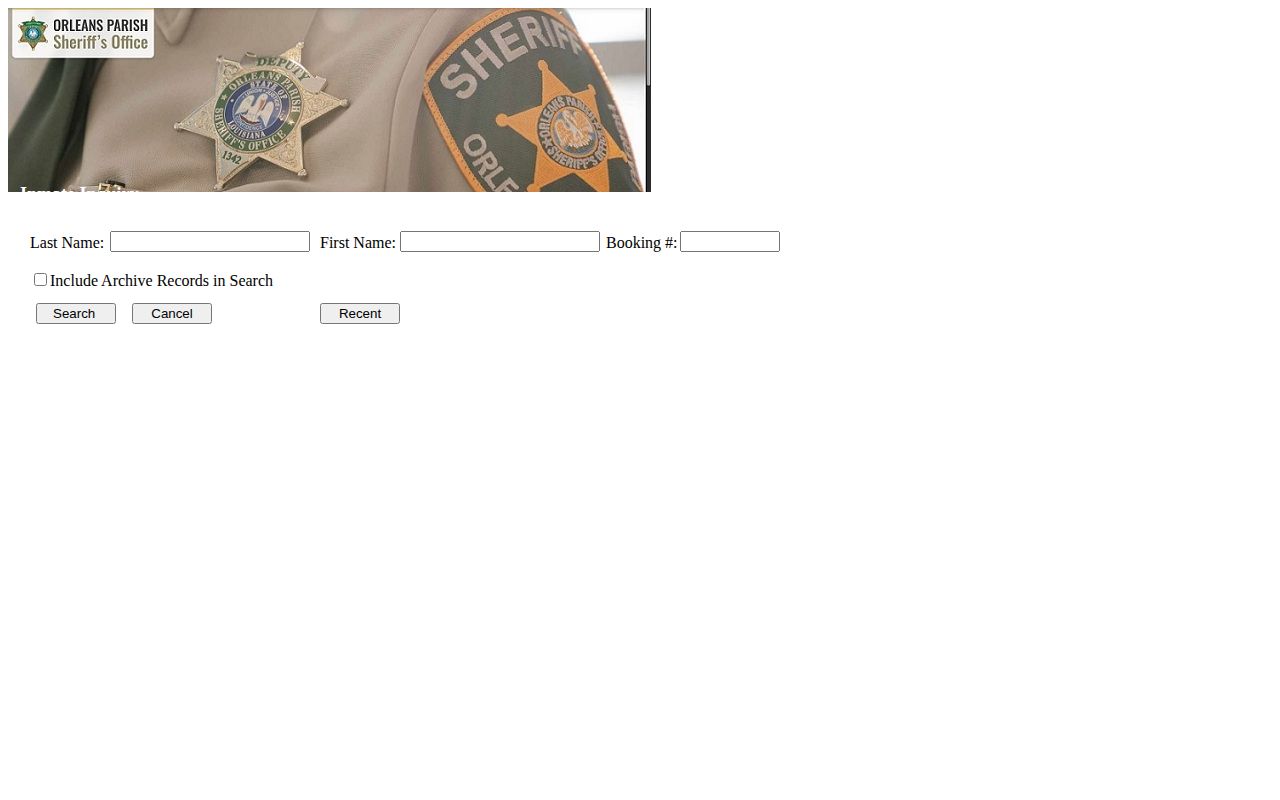
The archive checkbox and booking number are the key distinctions. The “Recent” control refers to recent bookings, not a recent-release feed.
Louisiana Search for Orleans Releases
DPS&C routes its public online search through Louisiana VINE. The official Inmate Information page says data update every 24 hours and can be searched by location, name, and ID or case number. It includes people in prison and people under probation or parole supervision. It does not cover every person who bonded out or finished a local Orleans matter.
| Search field | Use | Limit |
|---|---|---|
| Name | Begin a person search and compare identifying facts. | Common names require another identifier. |
| DPS&C number | Best match for a state correctional record. | Does not identify an OPSO-only booking. |
| ID or case number | Narrows results when the interface accepts it. | Use the label shown by the source. |
| Location | Distinguishes a facility or supervision setting. | Physical placement may differ from legal custody. |
When the web result is absent or unclear, call the Imprisoned Person Locator at 225-383-4580 with the DPS&C number or name and date of birth. DPS&C says the service can provide custody placement, facility contact, and “projected release date (if applicable).” A projection can change. A past discharge date or formal discharge record is better proof after release.
The state landing page records the scope and fallback. Review DPS&C’s locator instructions with the captured page.
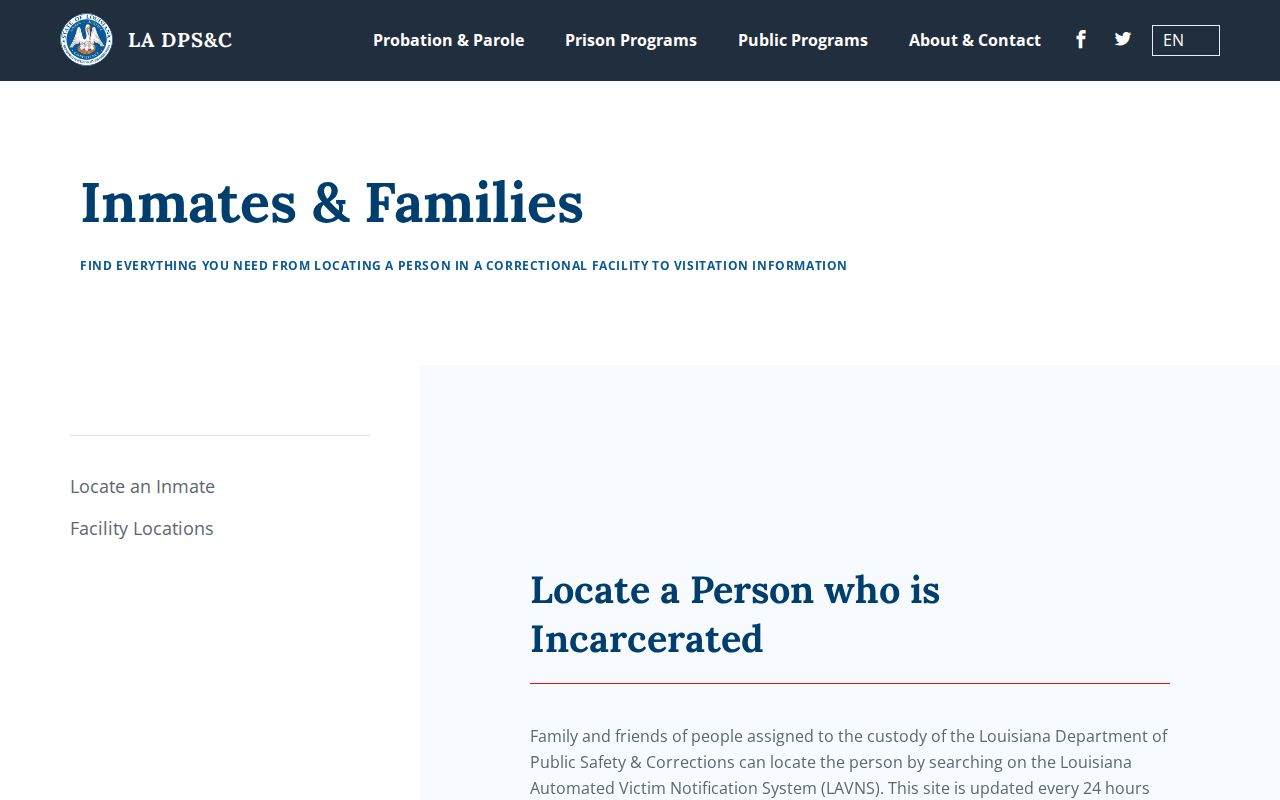
The official wording helps keep a projected date separate from an actual Orleans Parish release or state discharge.
Note: Record the date accessed because Louisiana custody placement, supervision status, and projected release information can change.
Orleans Parish Recent Release Records
No distinct official OPSO rolling 24-hour or 72-hour release feed was verified. The archive checkbox and Release Date column are the strongest online release path. The “Show Recent Bookings” button cannot be relabeled as recent releases. A new court order can also precede the physical exit and database update.
For a same-day question, check the live and archived booking, latest Docket Master entry, and Orleans VINE status. For a three-day span, repeat the comparison across each relevant date. If the evidence does not show the actual time, type, or destination, ask OPSO for the release transaction. Never build a release list by scraping the current roster.
Orleans Release Supervision Records
Leaving confinement may start, rather than end, supervision. A judge imposes probation. The Louisiana Committee on Parole may grant parole. A person released early through diminution may remain supervised as if on parole for the balance of the full term under R.S. 15:571.5. Full-term discharge may end DPS&C supervision unless another case or legal duty remains.
For probation, use the sentencing court’s minute entries. For parole, compare Committee dockets or decisions with DPS&C status. Probation & Parole explains the New Orleans district contact and the difference between release, supervision, an alleged absconder status, and final discharge.
Orleans Release Alerts and Locators
Louisiana VINE provides person-specific custody status and notification. Compare the reporting agency and identifiers before opening a result. “Out of custody” means out of that agency’s custody, not out of every system. Orleans also has a local VINE roster that the Louisiana Commission on Law Enforcement describes as updating every 30 minutes. It is a current-custody layer, not a historical release list.
If the person remains in custody, select the offered notification method and complete its confirmation or PIN step. For specified projected and actual state-prison notices, DPS&C currently distinguishes Louisiana Victim Outreach registration from ordinary LAVNS registration. The programs should not be treated as interchangeable.
Federal cases require separate tools. The BOP locator covers federal inmates from 1982 forward and may show a past release date or “Released.” USMS has no comparable public historical locator, so use the federal court docket and a targeted USMS request. These federal records do not prove release from OPSO.
Orleans Released Versus In Custody
The source must match the question. A live roster answers who an agency reports in custody now. A release record answers when and why one agency ended custody. A court file explains the legal event. State and federal locators cover their own systems.
| Source | Best use | What it cannot prove alone |
|---|---|---|
| OPSO live search | Current parish-jail booking | Historical community release |
| OPSO archive and release sheet | Past booking and OPSO exit | End of all other custody |
| Docket Master and Clerk | Legal disposition or release order | Exact physical exit time |
| DPS&C and Louisiana VINE | State custody, projection, supervision, or discharge | An OPSO-only release |
| BOP, USMS, or ICE | Agency-specific federal custody | Release from every system |
- Time served
- A sentence satisfied with custody credit already earned.
- Parole
- Release from incarceration while the sentence continues under supervision.
- Probation
- Court-ordered supervision imposed by the judge.
- Discharge
- An agency’s end of custody or sentence status, which must be read in context.
- Detainer
- A request or hold tied to another authority.
Note: A source can accurately report release from one agency while another agency still reports custody.
Orleans Parish Release Facilities
Orleans release research spans local, state, federal, immigration, and confidential juvenile systems. The Orleans Justice Center is the main adult booking complex. TDC is a local annex and transitional workforce setting with no separate public release database. Historical OPP units are record labels, not independent current locators. JJIC information follows juvenile confidentiality rules.
- Orleans Justice Center uses current and archived OPSO bookings plus the court record.
- Temporary Detention Center exits may require both OPSO and DPS&C checks.
- Orleans Parish Prison Historical Facilities follows older OPP and unit names through booking and case identifiers.
- Juvenile Justice Intervention Center uses authorized, confidential channels rather than an adult release search.
- Louisiana Department of Public Safety and Corrections supplies state custody and discharge information.
- Federal Bureau of Prisons reports sentenced federal custody and post-1982 release dates.
- U.S. Marshals Service requires court, custody-verification, or focused FOIA routes.
- ICE Detainee Locator covers current and limited recent immigration custody.
Each agency’s release date has its own scope. Preserve the name of the source, the wording shown, and the access date. Then request the originating record when the exact custody outcome matters.
Note: Choose the facility or system named in the record instead of assuming every Orleans case ends at OJC.
Orleans Release Orders Need Certification
Docket Master often survives after a booking drops off the live roster. It can show bond actions, minute entries, pleas, sentences, probation, dismissals, attachments, and later court events. Yet OPSO only supplies computer services for the display. Its disclaimer says the sheriff does not maintain or guarantee the completeness or accuracy of the court information, and the display is not an official document.
This institutional line matters in Orleans. Use Docket Master to locate the relevant event, then obtain the signed order, judgment, commitment, or certified minute entry from the Orleans Parish Clerk of Criminal District Court. A court order may authorize release before physical jail processing finishes, so keep the judicial time and OPSO transaction time separate.
When an Orleans Release Becomes ICE
An ICE detainer can turn an OPSO exit into a transfer instead of a return to the community. ICE describes a detainer as a request for notice of an impending release and up to 48 hours of added custody so ICE can assume custody. Label the OPSO and ICE events separately, with their own dates.
The ICE Online Detainee Locator accepts a nine-digit A-number and country of birth, or exact name and country of birth with birth-date fields. ICE guidance describes current detainees and people released from ICE custody within the prior 60 days. If the result is unclear, its detention information line is 1-888-351-4024, 8 a.m. to 8 p.m. Eastern, Monday through Friday except federal holidays.
Orleans Release Records Use Old Names
The modern Orleans Justice Center campus and Intake Processing Center opened in phases. City planning material records the 1,438-bed inmate, intake, and administrative complex opening in November 2015. Older records may instead say Orleans Parish Prison, OPP, Templeman, House of Detention, Community Correctional Center, or TDC.
Those labels do not create separate modern release databases. Follow the person through the booking and case numbers. Treat present OJC components as one OPSO custody system unless the record expressly shows that another agency accepted custody.
After an Orleans Parish Release
The New Orleans Criminal Justice Council includes the Reentry Task Force and links official return-to-community resources. It is a coordination and navigation channel, not a custody database. Confirm the Orleans Parish release through OPSO, the court, or DPS&C before using it for reentry navigation.
A person may still face probation, parole, diminution supervision, court dates, or agency reporting after leaving a facility. Official navigation can help connect a returning person with city and community providers, but it does not establish custody status or guarantee eligibility for a particular service.
Note: Reentry coordination begins after custody verification and cannot substitute for an OPSO, court, or DPS&C release record.