
Orleans 72 Hour Release Source
The Orleans Parish Sheriff’s Office does not publish a verified rolling three-day release page. Its current search is a starting point, not a ready-made window. The “Recent” control is labeled for recent bookings, which tracks entry rather than exit. A proper release review uses the separate archive option and the Release Date column. It then checks the associated booking detail and court case.
OPSO has not stated how long archived bookings remain online or how often the search data refresh. That prevents a promise that every exit will remain visible throughout a seventy-two-hour span. It also means the absence of a result has little value by itself. A narrow records request is the fallback when the search misses a known booking, while Docket Master and a certified minute entry can establish the case event behind the exit.
Check Orleans Three-Day Jail Releases
Set the window before searching. Write down its start and end in local time, then list all three calendar dates it touches. This makes midnight crossings clear. Use a full legal name, aliases, booking number, case number, and approximate booking date when available. One person may have several bookings, so confirm the event rather than relying on a name match.
- Open the OPSO detainees page and search the current record first.
- Open the OPSO archive search, select “Include Archive Records in Search,” and rerun the search. Review each matching booking and its Release Date.
- Check the booking detail for its charge, bond, case number, disposition, and active status.
- Review Docket Master events on each of the three dates. Keep the court event and physical release as separate timestamps.
- Compare the Orleans VINE status or saved alert, then request the precise release transaction when the sources conflict.
The official OPSO search entry point was successfully captured for this workflow.
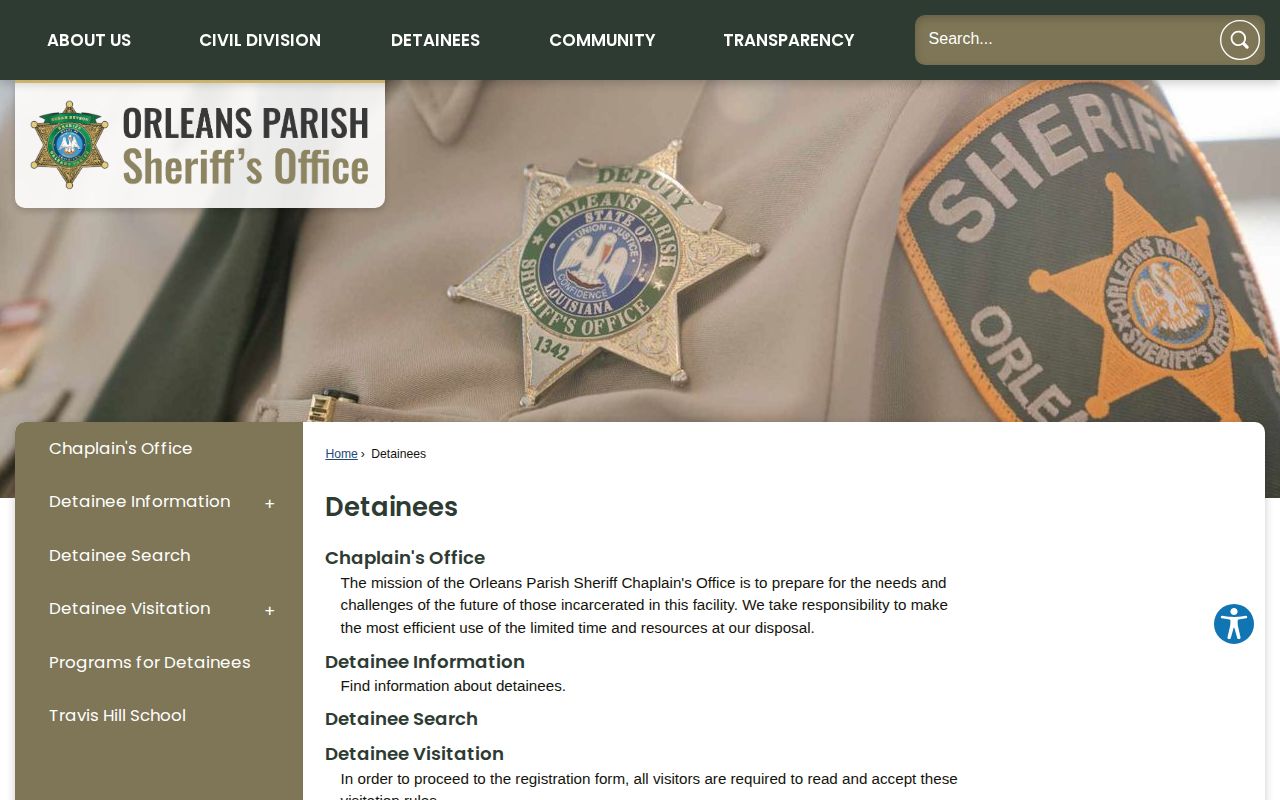
The entry page routes to live jail information, while released-person checking still depends on the archive option, case events, and a direct request when needed.
Orleans 72 Hour Release Fields
A three-day review must keep fields from different systems apart. The OPSO results table observed in the research carried booking identity, demographic details, Booking Date, Release Date, and an active flag. The detail view could add charge, bond, case, disposition, aliases, and prior booking history. Docket Master supplies court events, not a jail-release certificate. VINE supplies status and notifications from participating feeds, not a formal archival record.
| Field | Use in the three-day window |
|---|---|
| Booking number | Ties the person to one OPSO jail event and one detail record. |
| Booking Date | Separates recent intake from release and guards against misuse of the Recent Bookings control. |
| Release Date | Places the OPSO exit on one of the relevant dates without proving its reason. |
| Active flag | Shows whether OPSO reports the booking as active at the time of access. |
| Case and disposition | Routes the search to the court chronology that can explain bond, dismissal, sentence, or another action. |
| Release time and destination | Often require the OPSO release sheet or custody-status history when not shown online. |
Write labels exactly as displayed. Do not convert a court date into a release date or an OPSO date into proof that all custody ended. A transferred person may have a valid OPSO Release Date and remain confined elsewhere.
The detail page may also provide aliases and a booking history. Those items matter when the same person appears more than once during the date range. Compare the booking number and case number for each row, then keep the event that actually falls within the chosen span. A Photo column or photo slot is only an identity aid. It does not establish why custody ended, and the research found no published promise that OPSO preserves archived images for three days.
Orleans Weekend Release Timing
The main benefit of a three-day span is comparison, not a special sheriff list. A court order late on one day can be followed by OPSO processing on the next. A custody alert can arrive after the source transaction. These gaps can become more visible over a weekend or holiday, when the date of the legal decision and the date of physical exit are not the same.
Search all affected dates and preserve the source next to each time. The court minute tells what the judge ordered. The OPSO release transaction tells when that booking ended and may identify the exit code or receiving agency. A VINE alert tells when the system reported an event to the registrant. No one timestamp replaces the others.
- Court event
- The legal action, such as a bond change, dismissal, sentence, or release order.
- Jail transaction
- The physical custody event recorded by OPSO for the booking.
- Notification event
- The time a participating data feed generated or delivered a custody alert.
Note: A longer window reduces midnight confusion but cannot prove an exit when the underlying OPSO record is absent or incomplete.
Orleans Release Archive and Court
Orleans has a distinctive substitute for a rolling release feed. The OPSO search provides an explicit archive checkbox and a Release Date column, while Docket Master can carry the case trail beyond the short life of a roster result. Together, they often show that a booking ended and identify the court action that may have caused it.
The link is useful but not self-certifying. OPSO’s Docket Master disclaimer says the sheriff provides computer service for the public display but does not maintain or guarantee the completeness or current accuracy of the case information. The display is not the official document. For a firm court fact, obtain the certified minute entry from the Clerk. For a firm jail fact, obtain the OPSO release sheet or custody history. This archive-plus-court method is the correct Orleans alternative to an invented three-day feed.
A minute entry may show a release order, bond reduction, dismissal, credit for time served, probation sentence, or a commitment to state custody. Read the event narrowly. An order can authorize release before OPSO finishes identity checks, property return, paperwork, or transfer processing. Conversely, an archived OPSO date may show when local custody ended without explaining the judicial cause. The two records answer related but different questions.
Confirm Orleans Three-Day Releases
If the online trail is incomplete, address a focused public-record request to the OPSO custodian through the office’s current official channel. Include the full name and aliases, date of birth if lawfully known, booking number, approximate dates, and the court case number. Ask for the booking sheet, release sheet or chronology, actual release date and time, release type or code and its definition, destination or receiving agency, releasable holds, and any booking photo needed for identification.
Ask for an electronic copy and a cost estimate. No verified OPSO fee, fixed response duration, or archive-retention period was found. If part of the record is exempt, request the legal citation and segregation of material that can be released. A certified Clerk entry should be ordered separately when the legal basis must be proved.
Louisiana Public Records Law permits focused requests for releasable government records, subject to exemptions. A request should not demand the entire jail file. Juvenile, medical, victim, investigative, sealed, expunged, and confidential corrections material can require special treatment. Asking for the release transaction, code definition, and receiving agency gives the custodian a clear task and makes a response easier to compare with the three dates under review.
For a same-day event, Jail Releases: 24 Hours narrows the timestamps. For one named person whose next custody system is unknown, use the Orleans Parish released-inmate search to branch into DPS&C, BOP, USMS, or ICE.
Orleans Releases and Transfers
A person released on bond, after dismissal, for time served, or at the end of a local sentence may return to the community. Someone committed to Louisiana DPS&C may instead move into state legal or physical custody. A federal writ or case may lead to USMS custody, and an immigration detainer can lead to ICE. Another parish can also receive the person.
Check the agency named in the release record. DPS&C uses its state locator and records route. BOP covers sentenced federal inmates from 1982 forward, while USMS lacks a comparable public name archive for federal pretrial custody. ICE has its own locator and limited recent-release scope. Keeping those systems distinct prevents an Orleans jail exit from being misstated as freedom from all custody.