
Louisiana DPS&C Release Paths
Louisiana DPS&C is a statewide correctional system, not an Orleans Parish jail. A person convicted in Orleans Parish can be committed to state legal custody, remain temporarily in a parish facility, move to a state prison elsewhere, or serve under another authorized arrangement. Physical location therefore does not always identify the agency that calculates the sentence. OPSO may record the moment the person left local custody, but DPS&C supplies the state release or discharge event.
A state exit may be parole, release by diminution of sentence, full-term discharge, transfer, or another authorized change. Diminution is the reduction of time through credits allowed by law. Under R.S. 15:571.5, a person released by diminution can be supervised as if on parole for the balance of the original term. Thus release from prison and completion of the sentence are not the same fact. Verify both the custody event and any supervision that follows.
| State event | Where to confirm it |
|---|---|
| Projected release | DPS&C locator or telephone locator, using the exact date label. |
| Parole | Committee decision, DPS&C status, and field-supervision record. |
| Diminution release | DPS&C release record plus supervision status under the governing law. |
| Full discharge | Releasable DPS&C discharge information. |
| Transfer | Sending and receiving agency records, with each date labeled. |
Confirm Louisiana DPS&C Releases
Begin at the official DPS&C Inmate Information page. The department routes the online search through Louisiana VINE and says the information is updated every twenty-four hours. It can include people in prison and people under probation or parole supervision. Search by the most precise name, location, or ID and case number offered, then compare all displayed identifiers before selecting a result.
- Collect the full legal name, aliases, date of birth, DPS&C number, and Orleans case number when lawfully available.
- Open the state person search and compare agency, identifier, age, location, and status on possible matches.
- Record the exact custody label and the exact release-related date label. Do not turn a projection into an actual discharge.
- If the web result is missing or unclear, use the DPS&C telephone locator with the number or name and date of birth.
- For formal proof, request the releasable state discharge categories and compare them with the Orleans judgment or commitment.
The captured DPS&C locator landing page documents the state search route, update statement, telephone fallback, and “projected release date” wording.
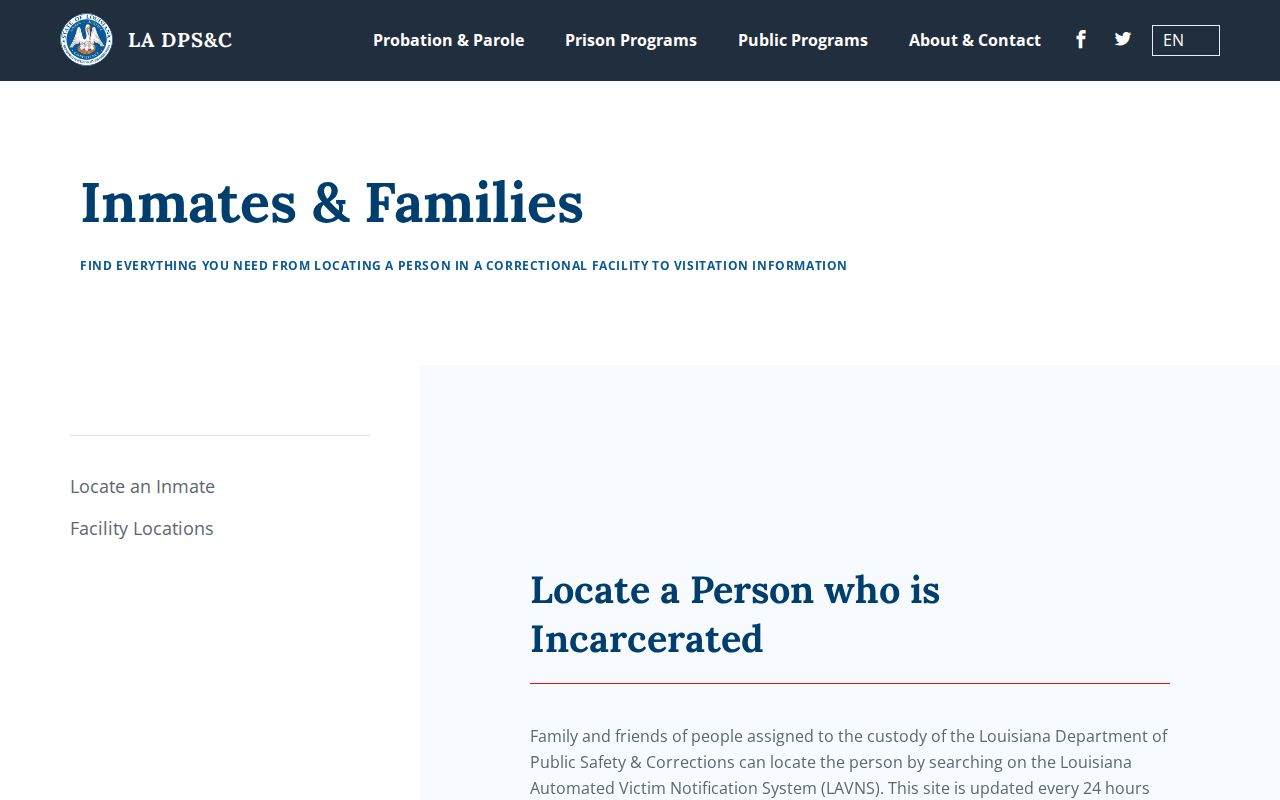
The landing page is the correct start for a state-custody release, while the Orleans jail search remains limited to OPSO bookings.
The telephone locator is a useful second channel when a name search is ambiguous. DPS&C says callers can use the department number or the person’s name and date of birth to obtain the assignment, facility contact information, and “projected release date (if applicable).” That quoted label matters. It should not be changed to “tentative” or presented as a promise. A caller should record when the information was received and ask which DPS&C record supports it.
A person who bonded out or whose Orleans charge was dismissed without a state commitment may never appear in the state search. Conversely, a person legally committed to DPS&C can remain physically at a parish facility. The Orleans court judgment is the dividing record. It shows whether the court imposed a state sentence, while DPS&C shows how that sentence is administered.
Louisiana DPS&C Release Dates
A projected release date is an administrative estimate based on the sentence, jail credit, offense date and class, concurrent or consecutive terms, diminution rules, credit loss or restoration, and later court action known to DPS&C. It is not the parole-eligibility date, a parole decision, the full-term date, or proof of actual discharge. Preserve the field’s exact label and the date the result was viewed.
The calculation can change. A court may correct the commitment, credit may be added, a different sentence may become controlling, or a new hold may prevent community release. Parole can be granted, delayed, rescinded, or revoked. Projected Release explains why parish and state formulas must not be mixed. When the person has already left custody, prefer the actual state release or discharge record over an old projection.
Louisiana DPS&C Diminution Rules
Louisiana good-time rules are date and offense specific. R.S. 15:571.3.1 provides a maximum fifteen-percent diminution framework for otherwise eligible felony offenses committed on or after August 1, 2024. It excludes specified categories, and credits can be withheld or forfeited. The often repeated idea that every Louisiana prisoner serves eighty-five percent is therefore wrong. It describes only the arithmetic effect of earning the full maximum for an affected eligible cohort.
Older offenses can remain under earlier structures in R.S. 15:571.3 and related law. Violence, repeat convictions, habitual-offender sentences, sex-offense provisions, revocation dates, and the type of custody can change the result. Parish-prison rules also differ. Obtain the Orleans commitment and offense date before interpreting a state projection, and let DPS&C supply the individual calculation rather than applying a percentage to the sentence.
Parole eligibility uses a separate legal framework. R.S. 15:574.22 generally makes a person committed for an offense on or after August 1, 2024 ineligible for parole unless an enumerated category applies. Older cases can involve the varied percentages and exclusions in R.S. 15:574.4. Eligibility is only the first possible date for consideration. It is not a hearing result or release date.
Louisiana DPS&C Discharge Records
R.S. 15:574.12 protects broad parts of prison, presentence, pre-parole, clemency, and department working files. Subsection G identifies public categories that include general identifying and sentencing information, disposition of criminal charges and incarcerations, and discharge date. A focused request should seek those releasable categories, not an entire institutional file.
Give the full name, DPS&C number, date of birth if lawfully known, Orleans case number, sentence, and approximate release period. Ask whether the date reflects parole, diminution, full-term discharge, or transfer and whether supervision continued, to the extent public. If material is withheld, ask for the legal basis and for releasable portions to be separated. Louisiana retention law does not require the public web locator to show a record forever.
R.S. 44:36 also separates agency retention from web visibility. The statute sets a specific floor for DPS&C adult-offender records after full-term expiration or death, but it does not require Louisiana VINE to preserve the same result online. A missing old web entry can therefore justify a focused archival request. Cite the department number, sentence, and expected discharge period so the custodian can locate the correct file.
- Release
- Departure from confinement, which may still be followed by supervision.
- Discharge
- Completion of the correctional status identified by the department; confirm whether it ends the full sentence.
- Parole
- Community supervision after conditional release by the parole authority.
- Diminution
- Statutory sentence reduction through earned credits for an eligible person.
Louisiana DPS&C Release Supervision
The Division of Probation and Parole operates district offices, including the New Orleans District. A judge may impose probation, the Committee on Parole may grant parole, and a diminution release may carry parole-like supervision. The public locator is not a universal record of every completed supervision case, and protected addresses, assessments, case notes, and presentence material should not be expected.
Use the official district-office directory and verify the listing before visiting. The research identified the New Orleans District at 1250 Poydras Street, Suite 450, fourth floor, New Orleans, LA 70113, with 504-962-4400. Ask a limited status question using the person’s full name, DPS&C number, and date of birth. A court minute remains essential for probation, while Committee and DPS&C records control parole.
Orleans Cases in State Custody
The Orleans Criminal District Court file supplies the judgment, sentence, commitment, and later judicial changes. DPS&C applies that legal record to state custody. If OPSO shows a local release near the sentence date, the event may mark transfer into state custody rather than release to the community. Match the OPSO booking number to the Orleans case and then use the DPS&C number for the state phase.
This two-system trail prevents a common error. “Not in the Orleans jail” does not mean “released from Louisiana custody.” Likewise, a later state release does not erase the earlier OPSO event. Preserve both dates, both agencies, and the type of each transaction. The Orleans Parish release search provides the full branch for local, state, federal, and immigration records.
A transfer note should name the receiving authority whenever the releasable record supplies it. That detail determines which locator or records office must be checked next.