
Orleans Projected Versus Actual Release
A projected release date is an administrative calculation based on the sentence and credits known to the custodian at that time. Louisiana DPS&C uses the exact phrase “projected release date” in its locator information. The date is not the same as parole eligibility, a parole hearing, the full-term end, or an actual discharge. Each describes a distinct stage. A past discharge event is stronger proof that a person left the reporting agency than an earlier estimate.
Pretrial custody is different. A person held at Orleans Justice Center before judgment does not yet have an imposed sentence to reduce. Release may depend on bond, recognizance, dismissal, acquittal, or a judge's order. Court action can authorize release before the jail completes physical processing. A transfer to Louisiana DPS&C, another parish, USMS, or ICE can also end the OPSO booking without returning the person to the community.
Scheduled versus actual: A projected date forecasts a possible custody exit. Confirm the actual release date, time, type, and receiving agency in the custodian's release record.
When a displayed date has already passed, record the field label and status. Then request the discharge or release transaction. A person may remain on probation, parole, supervised release, or diminution supervision after leaving a facility, so the physical exit and the end of legal control can occur years apart.
Find an Orleans Projected Release
Begin with the judgment or commitment. It shows whether the person is pretrial, serving a parish sentence, or committed to Louisiana DPS&C. Physical location can mislead. An Orleans defendant may be legally in state custody while housed in a parish facility. The state department, not the local roster, controls that state sentence calculation.
The official DPS&C Inmate Information page routes online searches to Louisiana VINE and states that data are updated every 24 hours. Search by location, name, or ID/case number. If the online result is missing or unclear, the department's telephone locator at 225-383-4580 accepts a DPS&C number or a name and date of birth. DPS&C says the service can provide the custody placement and “projected release date (if applicable).” Preserve that exact wording.
- Obtain the full name, date of birth, case number, booking number, and DPS&C number if lawfully known.
- Read the court judgment or minute entry to identify the sentence, offense date, jail credit, and legal custodian.
- For state custody, search the DPS&C route and record the current status, location, date label, and date accessed.
- For a parish sentence without hard labor, ask OPSO for the current release calculation and release transaction.
- For a pretrial case, follow bond and court events instead of expecting a computed sentence date.
- Near the date, recheck the custodian and obtain the actual discharge or transfer record.
The manifest image below shows the official Louisiana locator landing page.
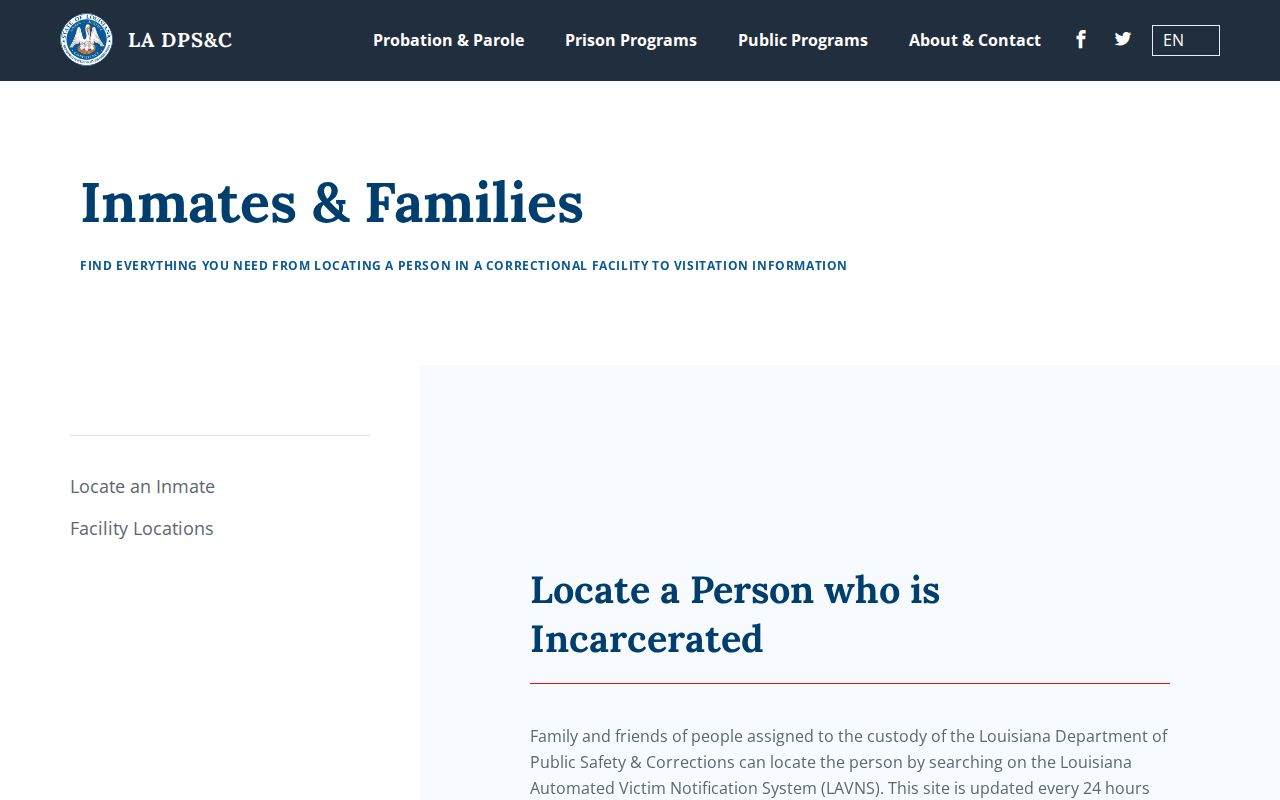
Its phone fallback and projected-date language are essential when the online person search cannot resolve an Orleans state-custody record.
Note: The OPSO live roster answers current parish custody, while DPS&C supplies the calculation for a state sentence.
Orleans Parish Release Calculations
Current R.S. 15:571.3(A) addresses a person in a parish prison who is convicted and sentenced without hard labor. Subject to statutory exclusions, the general eligible category earns 30 days of diminution for every 30 days in actual custody. A first conviction for a crime of violence has a different rate of three days for every 17 days. Diminution means a lawful reduction in time based on the statute and earned credit.
The parish rule does not govern every person at Orleans Justice Center. A pretrial detainee has no sentence to diminish. State or hard-labor custody, repeat violence, sex-offense rules, habitual-offender status, and the offense date can trigger a different provision or bar. Credit for prior jail time under Code of Criminal Procedure article 880 can also alter the calculation. Under the cited parish provision, the sheriff has authority to decide when good time is earned under the statute and applicable regulations.
Ask for the legal sentence, applicable cohort, custody credit, and current calculation. Do not infer a date from the booking date alone. A local physical address does not settle whether OPSO or DPS&C is the legal custodian.
Orleans State Release Date Rules
Louisiana now has a sharp offense-date dividing line. Under R.S. 15:571.3.1, an otherwise eligible person serving a felony sentence for an offense committed on or after August 1, 2024 may earn up to a maximum of 15 percent diminution. The statute applies in parish prison or DPS&C custody and excludes specified sex-offense convictions and habitual-offender sentences. Credits can also be withheld or forfeited.
Serving about 85 percent is the arithmetic result only when a person is in this cohort, qualifies, and earns the full maximum. It is not a universal Louisiana rule. Earlier offenses remain governed by the applicable version and cohort of R.S. 15:571.3 and related law. Some older eligible nonviolent state cases use very different earning rates, while violent, repeat, parish, sex-offense, and habitual-offender rules differ.
Parole eligibility is separate. R.S. 15:574.4 has offense- and history-dependent percentages and exclusions. In addition, R.S. 15:574.22 generally makes a person committed for an offense on or after August 1, 2024 ineligible for parole unless an enumerated statutory category applies. An eligibility date, hearing result, and prison release date must not be merged.
Orleans Custody Changes Projections
An Orleans sentence calculation begins with legal custody, not the name on the building. Louisiana can commit a sentenced person to DPS&C while that person remains physically housed in a parish facility. OPSO can therefore report the local booking while DPS&C controls the state sentence and prospective release information. The original Orleans court judgment supplies the sentence. The corrections department applies custody credit, sentence structure, and the governing diminution law.
The reverse distinction also matters. A person serving a parish sentence without hard labor may be subject to the parish-prison portion of R.S. 15:571.3 and the sheriff's lawful calculation. A pretrial detainee is in neither sentence cohort because no sentence has yet been imposed. Ask the court and custodian to identify the category before using any formula.
Several documents feed the result. The commitment states the term. The offense date selects the statutory cohort. Credit under article 880 accounts for qualifying prior custody. The judgment shows whether terms run at the same time or one after another. DPS&C or OPSO records show credits earned, withheld, forfeited, or restored. A new sentence or hold can become controlling even when an older projected date remains in a saved record.
- Concurrent
- Sentence terms run at the same time, subject to the judgment and law.
- Consecutive
- One sentence follows another, which can move the controlling release date.
- Jail credit
- Qualifying time already spent in custody that is credited under the court and statute.
- Legal custodian
- The agency responsible for the sentence record and calculation, even if another facility houses the person.
This parish-versus-state divide is why an “85 percent” shortcut fails. It can ignore the offense date, sentence type, exclusions, credit, and the agency with authority to compute the date.
Why Orleans Release Dates Move
Even a correct projection can change. It reflects the records then available and the sentence that controls on that date. A court correction, new hold, or change in credit can move the estimate. Parole may change the likely path without fixing the moment of physical release. The table identifies the Orleans-specific record to check for each cause.
| Change | Effect | Where to verify |
|---|---|---|
| Corrected commitment | Changes the legal sentence used in the calculation | Orleans court judgment and DPS&C |
| Prior-custody credit | Adds or corrects time credited toward the sentence | Court record and custodian calculation |
| Consecutive or concurrent terms | Changes which term controls and how terms combine | Judgment, commitment, and DPS&C |
| Credits earned or lost | Moves the projected exit earlier or later | OPSO or DPS&C, based on custodian |
| Parole action | May grant, deny, delay, rescind, or revoke conditional release | Committee minutes and DPS&C |
| Detainer or new case | May cause transfer or continued custody after one term ends | Holding agency and court |
A detainer is one agency's request that another agency hold or notify it about a person. The end of the Orleans booking can thus become a transfer rather than a community release. Record the OPSO exit and the receiving agency's custody event as separate dates.
Orleans Parole Dates Differ
The Louisiana Committee on Parole posts calendars and later meeting information. A scheduled hearing means only that the case was set for review. Outcomes can include a grant, denial, deferral, continuation, or rescission. A grant does not prove the person left prison on the hearing date. Conditions, an effective date, paperwork, and detainers can intervene.
Keep three fields in separate notes: the first eligibility date, the hearing or decision date, and the actual release date. If the person was released through diminution, R.S. 15:571.5 may continue parole-like supervision for the balance of the full term. That supervision end date is another distinct event.
Note: A parole decision changes legal status, but only the custodian's release transaction confirms the physical exit from custody.
Confirm Orleans Actual Release
Use notification as a prompt, not a certificate. Louisiana VINE can report a custody event from a participating agency. A released or out-of-custody result means the person left that reporting agency. It does not rule out DPS&C, federal, ICE, or another parish custody. VINELink Inmate Search explains how to record the agency, event text, and time.
For a state sentence, ask DPS&C for the actual discharge date and type under the public categories in R.S. 15:574.12(G). For a local booking, start with the OPSO Detainees page, then request the release sheet or custody chronology. Specify the full name, booking number, approximate dates, release date and time, release type or code, and receiving agency if transferred. For the judicial basis, inspect Docket Master and obtain the minute entry or judgment from the Orleans Clerk.
When requesting a calculation, ask for the projected date label, the sentence or commitment used, custody credit then applied, the offense-date cohort, and whether another term or hold controls. If the date changes, ask which input changed. That answer is more useful than comparing two unlabeled screenshots. For a past event, request the actual discharge date rather than a reconstruction from an obsolete projection.
A complete answer often uses two records. The custodian proves when and how custody ended. The court record explains the order or case event behind it. The broader Orleans Parish release-record search covers that two-record method and the federal and immigration branches when the person leaves local custody.