
Orleans 24 Hour Release Source
No official Orleans Parish Sheriff’s Office page was verified as a rolling list of releases from the prior day. The OPSO search does have a “Recent” control, but the control means recent bookings. It must not be treated as a list of people who left jail. The useful released-person feature is different: a searcher can select “Include Archive Records in Search,” then review the Release Date column and the booking detail. OPSO has not published a guaranteed archive-retention period or update interval in the reviewed sources.
This makes a date-bounded inquiry a record-matching task. Search for the person or booking, preserve the displayed release date, and then test what that date means. Bond, dismissal, time served, completion of a local sentence, placement on supervision, and transfer are distinct outcomes. A blank live result alone proves none of them. The current roster shows reported OPSO custody at the time of access, while the archived booking can document an older jail event.
Check Orleans Same-Day Jail Releases
Begin with the official OPSO detainees entry point. Use the exact name, OPSO booking number when known, and a narrow date range. A common name can return more than one person, and one person can have more than one booking. Match the booking event, not just the name.
- Run the OPSO search for the current record and note whether the booking is marked active.
- Run it again with “Include Archive Records in Search” selected. Compare the booking number, booking date, and Release Date column.
- Open the correct detail record. Review the charge, bond, case number, disposition, and any release information shown.
- Check the latest Docket Master event by case number. Look for a bond action, dismissal, sentence, time-served entry, release order, or transfer-related event.
- Compare the Orleans VINE status. If the record still conflicts, request the OPSO release transaction and a certified court minute entry.
For one named person rather than a same-day window, the full sequence is set out on the Orleans Parish released-inmate search. It adds state, federal, and immigration checks when the case points outside OPSO.
The captured OPSO inmate search shows the controls that matter for this task.
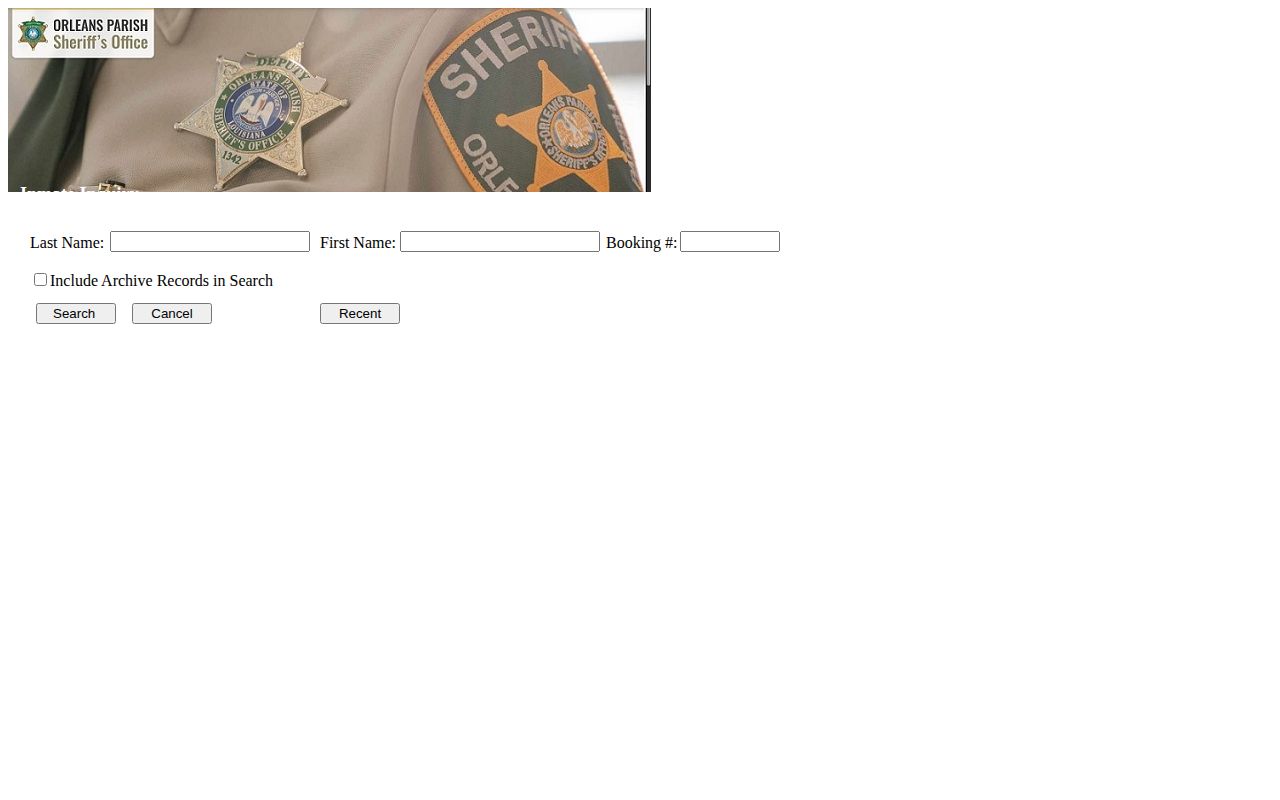
The archive checkbox and booking identifiers make the form useful after a person drops from the live roster, while the release still needs a court or custodian check.
Orleans 24 Hour Release Fields
OPSO results observed during the research displayed booking and identity fields plus a Release Date and active flag. A detail record can add charge, bond, case, disposition, alias, and booking-history data. The table separates what is visible from what usually requires a focused records request.
| Field | What it establishes |
|---|---|
| Booking number | Identifies the jail event and prevents confusion between separate bookings. |
| Booking date | Marks entry into the OPSO booking process, not the date of release. |
| Release Date | Shows the date OPSO reports the booking as released; it does not by itself name the destination. |
| Active flag | Helps distinguish a reported active booking from an archived one at the time searched. |
| Charge, bond, and case | Connects the booking to the court file that may explain the exit. |
| Release time, code, destination | These should be requested from the custodian if the online detail does not show them. |
A Photo column and photo slot may appear, but availability varies. An observed detail said “No Photo.” Neither a photograph nor its absence establishes release. Record the access time because dynamic results can change.
The detail page can also carry an inmate identifier, demographics, aliases, charge statute and description, bond type and amount, and prior booking history. Those fields help match the right event, but they do not replace the release transaction. A disposition label may refer to the charge or case rather than the physical custody step. If the detail omits release time, reason, or destination, state that gap plainly and ask OPSO for those exact fields.
Note: OPSO has not published a promise that archived release entries remain visible for a set number of hours or days.
Orleans Release Docket Trail
Docket Master often survives the brief roster moment. It is a case-event chronology that may show bond settings, appearances, minute entries, pleas, sentences, probation, dismissals, and later court action. An entry can explain why a booking ended. It is especially useful when the jail result has already moved to the archive or provides only a date.
Yet the OPSO Docket Master carries a key local limitation. OPSO supplies computer services for the court display but does not guarantee that the case information is complete or current. The display is not the official court document. When the legal basis for release matters, order the certified minute entry from the Orleans Parish Clerk of Criminal District Court. A signed release order can also precede physical jail processing, so keep the court-event time and jail-release time separate.
- Release order
- A court directive that authorizes release; it may precede the physical exit.
- Time served
- A sentence satisfied by credit for time already held.
- Transfer
- OPSO gives custody to another agency rather than releasing the person to the community.
Orleans 24 Hour VINE Check
The official Orleans Louisiana VINE roster is a current-custody and alert channel. The Louisiana Commission on Law Enforcement documents a thirty-minute update cycle for the Orleans roster and anonymous registration from a selected person’s record. That cadence helps with a same-day check, but it is not a certified archive and does not turn a disappearance into proof of community release.
If an alert reports a custody change, save the event time and reporting agency. Then compare it with the OPSO archive Release Date and court record. An alert may follow the source transaction, and “out of custody” means out of the reporting agency’s custody. It does not exclude a transfer. VINELink also depends on agency feeds, so direct confirmation remains vital when timing or destination matters.
When the case resulted in a Louisiana state sentence, check the DPS&C Inmate Information route as well. DPS&C says its online information is updated every twenty-four hours and may include people in prison or under probation or parole supervision. The department’s telephone locator can help when the web result is unclear. A state result should be read for its exact status and date label because a projected release date is not an actual discharge.
Request Orleans Same-Day Release Proof
When the archive is missing, delayed, or unclear, send a narrow request to the OPSO public-records custodian through the current official channel. Give the full name, aliases, booking number, date of birth if lawfully known, approximate booking and release dates, and the court case number. Ask for the booking sheet, release sheet or custody-status history, actual date and time, release code and its meaning, destination or receiving agency, releasable hold data, and the booking photo if needed.
Request an electronic copy and ask for a fee estimate before chargeable copying. No verified current OPSO copy fee or guaranteed response time was found, so no fixed cost or delivery promise should be assumed. If material is withheld, ask for the cited exemption and for nonexempt portions to be separated and produced under Louisiana Public Records Law.
Louisiana law separates record retention from online display. R.S. 44:36 provides a general retention floor unless another law or approved schedule applies, but it does not force OPSO to keep an archive result online for any specific recent-release window. That is why a dated public-record request can still be useful after a web entry disappears. The request should be narrow enough to locate the booking and should distinguish community release from transfer.
A three-day comparison can help when processing crossed midnight. Jail Releases: 72 Hours treats each date as a separate source check rather than pretending there is an official rolling feed.
Orleans Release Versus Custody
A live OPSO result generally points to current reported parish-jail custody. An archived release date says that OPSO relinquished custody on that booking. A DPS&C record may then show state incarceration, parole, probation, or a projected date. A federal court or USMS event can explain a federal movement, while ICE’s locator can reveal immigration detention within its stated scope.
Keep each agency’s date and label intact. “Released from OPSO” is narrower than “free from all custody.” This source-by-source method prevents a transfer from being misread as a community release and keeps a court order distinct from the later physical exit.